Just doing a little back of the envelope calculation for the inflation rate on my grocery bill.
I know that 9 years ago, my average grocery bill was $75 a week.
Over the last 3 months, my average grocery bill has been $175 a week.
According to my calculations, that's an increase of 233% over the past 9 years, or roughly 25% inflation per year.
Because the price of a pound of peaches varies from season to season, food costs are too volatile to be included in core inflation rate calculations. Because I can now buy a computer with 233% more processing power for 50% less than it would have cost me in 2001, somehow everything balances out.
If the inflation of the average grocery bill (not individual food costs) were included in the core inflation rate, there would be panic in Washington and New York. Regimes would fall. Banks would collapse. That's why when they talk about the economy, they brush the ugliest numbers under the carpet. Those numbers are too volatile.
Hell yes they're too volatile. They keep going up! At 25% a year!
Showing posts with label consumerism. Show all posts
Showing posts with label consumerism. Show all posts
Friday, June 04, 2010

Monday, September 14, 2009
False Advertising
If you have the Yahoo toolbar on your browser, have you noticed lately that it says you have new emails waiting when you actually don't?
At first I thought it was just a bug. But after clicking on it a dozen times or so and finding no new email messages, it finally dawned on me what Yahoo is doing.
They're driving traffic and spinning their hit counters. The toolbar equivalent of phishing.
I wonder if Yahoo's advertisers realize they're paying for empty clicks.
At first I thought it was just a bug. But after clicking on it a dozen times or so and finding no new email messages, it finally dawned on me what Yahoo is doing.
They're driving traffic and spinning their hit counters. The toolbar equivalent of phishing.
I wonder if Yahoo's advertisers realize they're paying for empty clicks.
Thursday, August 20, 2009
Pointing Out the Obvious
From an ad for GM auto insurance:

I still wouldn't be able to afford this car.
Monday, January 12, 2009
Doing My Part for the Economy
New socks. New underwear. I'm feeling good now, like I'm walking on sunshine with a pantload of clouds.
Sunday, January 04, 2009
It Doesn't Take a Little Einstein
This is another installment of Adventures in Obscenely Excessive Packaging. Our environmental criminal today is Little Einstein's Dominoes game, brought to you by the wonderful world of Disney.

This pointless game, which is inferior in every respect (save Disney's profit margin) to traditional dominoes, comes wrapped in lovely baby-choking, fish-killing plastic.

Nothing unusual about that. Within the box, you get one carboard divider:

One page of instructions which tells you how to play the different games. All the games are played exactly the same way - the only difference is the pictures on the dominoes.

And one stack of cardboard dominoes. Yes, cardboard. Wrapped in more plastic.

That's all. The cardboard divider splits the interior of the box into two equal compartments. One compartment is for the single sheet of instructions. Half a box for one piece of paper. At least it wasn't just air.

The other half of the box contains the stack of cards which, as you can see, are slightly larger than business cards.
All told, the entire contents of the box consume roughly 10% of the space.

That, my friends, is obscene waste you can believe in. But hey, it makes kids smarter because... well, because it's called Little Einsteins. Or something. And what parent wouldn't do anything to raise a little Einstein, right?
The real purpose here is that nobody would pay $7 for a tiny pack of fake cardboard dominoes, no matter whose pictures are on them, no matter whose name is on the label.

This pointless game, which is inferior in every respect (save Disney's profit margin) to traditional dominoes, comes wrapped in lovely baby-choking, fish-killing plastic.

Nothing unusual about that. Within the box, you get one carboard divider:

One page of instructions which tells you how to play the different games. All the games are played exactly the same way - the only difference is the pictures on the dominoes.

And one stack of cardboard dominoes. Yes, cardboard. Wrapped in more plastic.

That's all. The cardboard divider splits the interior of the box into two equal compartments. One compartment is for the single sheet of instructions. Half a box for one piece of paper. At least it wasn't just air.

The other half of the box contains the stack of cards which, as you can see, are slightly larger than business cards.
All told, the entire contents of the box consume roughly 10% of the space.

That, my friends, is obscene waste you can believe in. But hey, it makes kids smarter because... well, because it's called Little Einsteins. Or something. And what parent wouldn't do anything to raise a little Einstein, right?
The real purpose here is that nobody would pay $7 for a tiny pack of fake cardboard dominoes, no matter whose pictures are on them, no matter whose name is on the label.
Wednesday, December 10, 2008
BOHICA, or Happy FU Day
The only thing I hate worse than paying $4.39 a gallon for gas is paying $1.39 a gallon.
The drastic drop in oil prices coinciding, as it has, with the collapse of the credit markets is clear evidence that the only thing producing those outrageous gas prices of only six months ago was speculators playing Las Vegas with our economy and our lives. It wasn't demand. It wasn't Peak Oil. It was the same greedy fucks who brought us the sub-prime mortgage crisis. They fucked us going in, and now they're fucking us going out - we get fucked and they get our money every time, and the whole thing is designed to be that way.
The drastic drop in oil prices coinciding, as it has, with the collapse of the credit markets is clear evidence that the only thing producing those outrageous gas prices of only six months ago was speculators playing Las Vegas with our economy and our lives. It wasn't demand. It wasn't Peak Oil. It was the same greedy fucks who brought us the sub-prime mortgage crisis. They fucked us going in, and now they're fucking us going out - we get fucked and they get our money every time, and the whole thing is designed to be that way.

Embrace the suck.
Friday, November 28, 2008
Prices and Workers Falling
People so crazy.
So crazy they kill.
For what? Super low prices.

And can you imagine dying on behalf of Wal-Mart?
Merry it was to laugh there --
Where death becomes absurd and life absurder.
For power was on us as we slashed bones bare
Not to feel sickness or remorse of murder.
So crazy they kill.
For what? Super low prices.

And can you imagine dying on behalf of Wal-Mart?
Merry it was to laugh there --
Where death becomes absurd and life absurder.
For power was on us as we slashed bones bare
Not to feel sickness or remorse of murder.
from Apologia pro Poemate Meo
by Wilfred Owen
Wednesday, October 29, 2008
Maybe This Will Work
A GM merger with Chrysler is like a troubled couple with an unwanted pregnancy deciding to get married, thinking it will fix their problems.
What they need to do is realize just how badly they've been betrayed by the oil industry and release some of that technology they've been sitting on for forty years. In 1992 my wife had a Chevy Nova that consistently got 40 miles per gallon on the highway. Later, we had a 1996 Saturn SL-1 that consistently got 30 mpg in the city. But I am lucky if my 2003 Saturn Ion gets 26 mpg in the city today. I have to feather the gas and drive with no air conditioner to get the same mileage I got on bad days in my old SL-1. There are hybrids, supposedly fuel efficient, that don't get the gas mileage our old Nova got. There is no excuse for this, unless these cars are intentionally designed to burn more gas, which wouldn't surprise me at all.
They don't need to spend years and billions of dollars designing new technologies. Just dust off the stuff they put in mothballs years ago, probably at the request of the oil companies. To GM and Chrysler I ask, have the oil companies shared any of their record profits with you? No, they're letting you go bankrupt. So return the favor. By 2010, you could be producing sedans that get 50 mpg. You'd make a killing. Drop your inventory to about 8 models, give them all killer gas mileage, and watch your profits soar.
Or you could keep carrying water for the oil companies. And in five years, you'll all be employees of Toyota. Those of you who still have jobs, that is.
What they need to do is realize just how badly they've been betrayed by the oil industry and release some of that technology they've been sitting on for forty years. In 1992 my wife had a Chevy Nova that consistently got 40 miles per gallon on the highway. Later, we had a 1996 Saturn SL-1 that consistently got 30 mpg in the city. But I am lucky if my 2003 Saturn Ion gets 26 mpg in the city today. I have to feather the gas and drive with no air conditioner to get the same mileage I got on bad days in my old SL-1. There are hybrids, supposedly fuel efficient, that don't get the gas mileage our old Nova got. There is no excuse for this, unless these cars are intentionally designed to burn more gas, which wouldn't surprise me at all.
They don't need to spend years and billions of dollars designing new technologies. Just dust off the stuff they put in mothballs years ago, probably at the request of the oil companies. To GM and Chrysler I ask, have the oil companies shared any of their record profits with you? No, they're letting you go bankrupt. So return the favor. By 2010, you could be producing sedans that get 50 mpg. You'd make a killing. Drop your inventory to about 8 models, give them all killer gas mileage, and watch your profits soar.
Or you could keep carrying water for the oil companies. And in five years, you'll all be employees of Toyota. Those of you who still have jobs, that is.
Tuesday, October 21, 2008
The Twinkie Defense
 In today's installment of Fun Food Facts, we bring you...
The Otis Spunkmeyer Banana Nut Muffin, one of the most unfortunately-named food products around.
The Otis Spunkmeyer Nanana But Muffin sports these nutritional benefits:
- Reduced Fat: No more than 30% of calories from fat and no more than 10% of calories from saturated fat
- Zero Trans Fat
- Whole Grain
- No more than 30% added sugar by weight
But look carefully at the packaging and you see that each Otis Spunkmeyer Banana Mut Nuffin is considered to be two servings, as in the number 2, to be eaten by two people, though it is quite clearly just one muffin, unlike the Twinkie.
And each of those servings within that one muffin contains 210 calories. Or, to be more realistic, each muffin packs a nutrional wallop at 420 calories. Which is also how many calories are in a McDonald's Quarter Pounder with Cheese. And although it is made with whole grain, the Otis Spunkmeyer Manana Nut Buffin actually has less dietary fiber than the Quarter Pounder. Go figure.
In fact, you might as well open a package of Twinkies, as two Twinkies have less fat, less cholesterol, and 120 fewer calories than one Otis Spunkmeyer Banana Nut Muffin. Yummmm!
Tune in next week as we deconstruct the healthful benefits of Yoplait Banana Cream Pie Yogurt and answer the question, what is it with this dude and bananas?
Friday, June 27, 2008
The New AT&T
 52-cents a minute!
That's the charge for phone calls from Memphis, TN to Olive Branch, MS. A distance of less than 3 miles. 52-cents a minute.
It's almost like AT&T is trying to price itself out of business. Will I ever again use my home phone to call a local number just across the state line? Of course not. Who in their right mind pays 52-cents a minute for a conversation that could be made cheaper by driving - even at $4.00 a gallon! For the price of that 30 minute call, I could buy 4 gallons of gas, enough to drive the distance of that phone call roughly 17 times!
But I suppose buying Senators, Representatives, and presidential candidates can get expensive.
Monday, December 31, 2007
Drown It in a Bag
The time has come, the walrus said, to kill the recording industry.
The RIAA is now arguing that copying your CDs to your computer is piracy. Even if you never share the song files, it's piracy. Even if you purchased the CDs legally, if you make a copy, for any reason, it's piracy.
I suggest we the buying public stop buying CDs produced by the recording industry. I suggest we stop buying any music - CDs or downloads - that is produced via the traditional recording industry. I will be the first to make the vow. From this day forward, I will only purchase independently produced and distributed music.
Let the recording industry legislate and litigate itself onto the dung heap of history, where it belongs. I will not give it one more dime. Ever.
The RIAA is now arguing that copying your CDs to your computer is piracy. Even if you never share the song files, it's piracy. Even if you purchased the CDs legally, if you make a copy, for any reason, it's piracy.
I suggest we the buying public stop buying CDs produced by the recording industry. I suggest we stop buying any music - CDs or downloads - that is produced via the traditional recording industry. I will be the first to make the vow. From this day forward, I will only purchase independently produced and distributed music.
Let the recording industry legislate and litigate itself onto the dung heap of history, where it belongs. I will not give it one more dime. Ever.
Tuesday, December 04, 2007
How Not to Innovate
 In a previous post, I lamented the uncertain future of the written word and begged for a new innovation to rejuvenate the publishing industry.
Meet Kindle, Amazon.com's "answer" to my prayer. Sony has a similar device.
Now, it's true that Ebooks have been around for a few years and they've never really caught on. The difference between older versions and Kindle are the features (instant wireless downloads, readability, etc.) At first glance, it looks like something I would buy.
At first glance only.
First of all, Kindle costs $399.99. That's a hell of a big pile of dough, but it's well within the range of what I spend on books each year.
What's really bothersome is the price of a Kindle book. Check this out:
The hardcover edition of Sacco and Vanzetti by Bruce Watson costs $17.13.
The Kindle edition of Sacco and Vanzetti by Bruce Watson costs $15.42.
That's a savings of just $1.71. For an electronic version that, compared to an actual paper book, costs almost nothing to produce. Sure, the technology is bound to have associated costs - licenses and whatnot - but compared to the cost of printing and shipping 10,000 hardback books, 10,000 Kindle books probably don't cost more than a couple of cents per book.
In my opinion, few people are going to spend $400 for an electronic book reader (no matter how cool) and then have to turn around and pay almost as much for an electonic book as they'd pay for the real thing. I know I wouldn't. If I'm slapping down $400 for a Kindle, I wouldn't pay more than $4 for a book. If that much.
The only thing I like about the Kindle is that it removes the giant corporate publishers and distributors from the publishing model. With technology like this, all that would be needed from a publishing company is a good editor, a copy editor, and a typesetter. Which means that eventually small publishers will be able to compete with big publishers. Once that happens, more books and better books will become available. And that's a good thing.
But before that can happen, a Kindle book (or its equivalent) has to reflect the real cost of production. The real cost is about 40% of the cover price - that is roughly the price the distributor pays the publisher for each copy of a book. The other 60% that you pay for a book goes to the distributor and the bookseller.
Of the first 40%, the author gets anywhere between 4% and 12%, on average. Bigger authors get a bigger cut. So take 12% off, leaving 28% going to the publisher to cover the costs of editing, typesetting, printing, and promotion, with something left over for profit or they go out of business. With an e-book, you get rid of the cost of printing, and since most publishers spend next to nothing on promotion, and since you lose the cost to the author of the return reserve, you end up with an ebook costing maybe 25% of the cover price to produce to the electronic file stage.
Bookstores take their cut of the cover price, but since Ebooks cost next to nothing to store (since all you're really housing is one copy), and since Ebooks don't require employees to sell, the seller's cut of the price should drop, too. So let's give them 25% of the cut to run the website, pay for bandwidth and wireless capacity, and make a profit. That brings us to 50% of cover price.
But since hardbacks and trade paperbacks are priced by quality of print production, the real value of an electronic book should be based on 50% of the cover price of the cheapest edition - the mass market paperback. Average price of a mass market book is $6.99, therefore the base price of an e-book should be $3.50. I can see paying a bit more for more popular authors to cover their larger cut of the royalties, because they are more in demand and therefore can command a higher price (or negotiate with the publisher for a lower price in the hope of increasing number of sales). Thus my $4 top price.
$15 for an e-book is certain, in my opinion, to kill the technology before it has a chance to get off the ground. Not to mention the fact that a $400 Ebook machine limits your customer base to the upper third of readers. It won't do a thing to get more people reading, and getting more people reading is where we should be headed with new technologies, not excluding potential new readers by pricing them out of the reading market.
If I were Amazon, I'd practically give Kindles away and then sell e-books significantly cheaper than paper books. You do that and you'll corner the publishing market, especially if Amazon publishes the books and take the publisher's cut for themselves. It's almost like they don't want to succeed, or they're afraid of succeeding, since success will utterly rewrite the way books are produced. And that's a scary thing for everybody - booksellers, publishers, and authors alike.
Wednesday, February 22, 2006
Don't Drink the Water
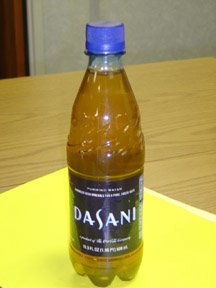 Dasani is filtered through a state-of-the-art purification system and enhanced with minerals for a pure clean taste that can't be beat.
Just make sure you drink it before the brown shit starts to grow.
We found this bottle at the back of the fridge in the breakroom at work. It has a date of Nov0606 on it. As you can see, it is the color of muddy water and has all sorts of interesting things floating around inside it.
And it has never been opened.
http://www.makeyourmouthwater.com/
Subscribe to:
Posts (Atom)